Follow us on:

Den Sure Nisse


Our Rating: 3.06 / 5
Den Sure Nisse from Humleland is a kettle-soured, heavily fruited beer built on strawberry, pink guava, and blueberry purée. Bright acidity leads, with fresh strawberry upfront and darker, earthy notes trailing behind. Carbonation keeps it brisk, though balance drifts as the glass warms. Festive artwork aside, it drinks like a straightforward year-round sour release profile.

Beer Name: Den Sure Nisse (The Grumpy Elf)
Brewery: Humleland (Hop Land)
Beer Style: Fruited Sour (Kettle Sour)
Alcohol: 7.0%
Taste Notes: Fresh strawberry, pink guava, light floral tropicals, earthy, blueberry, tart
Serving: Can
Serving Size: 440 ml (14.9 fl. oz.)
Grumpy or Sour?
Christmas beers tend to lean hard on spice, sweetness, or nostalgia. When it’s Christmas sours, it tends to be cherry, coconut and maybe some warm spices like cinnamon. Den Sure Nisse, translated plainly as The Grumpy Elf, takes a less sentimental route and says so directly on the label. The beer comes from Humleland, whose name translates to Hop Land, a Danish brewery probably best known for its straightforward, fruit-forward styles. This is presented as a kettle-soured beer, fruited heavily and unapologetically, positioned as a seasonal sour.
Humleland keeps the process simple and concrete: wort is soured in the kettle, then 120 kilos of fruit purée is added directly to the fermenter, split 60% strawberry, 40% pink guava, 20% blueberry,l and a 7% ABV to carry it. Beyond the artwork, there’s very little here that points toward December. No spice cues, no warming aromatics, no nods to baking or winter fruit. Strip away the red can and the angry elf, and this reads as a year-round fruited sour that happens to wear a festive jumper.
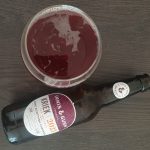
In our glasses, the colour lands firmly in pale copper-red territory, hazy and opaque, closer to diluted fruit cordial than anything malt-driven. Foam barely forms and disappears quickly, leaving the surface mostly still apart from fine carbonation rising through the haze. Carbonation feels medium-high on the palate, already noticeable before any flavour really settles.
The aroma opens with strawberries first and loudest, fresh rather than confectionery, followed by a sharper tropical acidity from the guava. Blueberry stays quieter, adding a darker, slightly earthy undertone that rounds out the nose as the beer warms. There’s a brief floral note early on, likely guava-adjacent, before the fruit settles into something more grounded and less perfumed.
The opening taste follows the aroma closely. Tartness leads, clean and direct, before strawberry sweetness spreads across the palate. Guava adds a red, lightly floral lift mid-palate, while the finish brings a faint bitterness and earthiness that point back to the blueberry. For a brief moment, the body feels creamy and coating, then thins out quickly under the carbonation, leaving a brisk, sour-driven finish that resets the palate for the next mouthful.
The Final Straw…berry
As the glass empties and the temperature rises, the balance shifts in small but noticeable ways. Strawberry remains the anchor throughout, still reading as fresh fruit. The guava loses some of its early aromatic sparkle, becoming sweeter and less expressive, while the blueberry grows more assertive in flavour, bringing an earthy bitterness that sits underneath the acidity.
Carbonation plays a bigger role over time. At this level, it pushes the beer toward a lighter, almost airy mouthfeel, which works against the creamy texture suggested earlier.

The result is a beer that feels both coating and thin in quick succession, a contrast that becomes more obvious halfway through the glass. The tartness stays firm and persistent, and for some of us, it begins to outpace the fruit complexity, especially as the guava fades.
For BJCP comparison, the most fitting match in the 2021 guidelines is probably BJCP 29A Fruit Beer, still noting that the BJCP sorely lack diversified style guidelines for the sour styles. The structure fits: fruit-forward aroma and flavour lead, the underlying beer stays secondary, and the main question becomes integration and balance. Here, strawberry carries the centre cleanly, guava supplies the bright tropical lift early on, and blueberry increasingly contributes earthy bitterness through the finish, which shapes the back half of the can more than the first.
Untappd lists Den Sure Nisse as a “Sour – Fruited” with an average rating of 3.46, which feels reasonable, if not a tad high, to us. Our group landed lower, clustering tightly around the low-threes, averaging just over 3 overall.
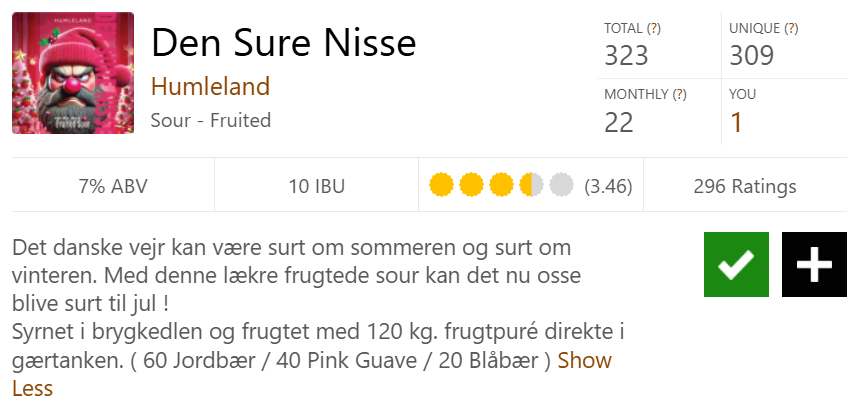
That difference reflects how the beer drinks across a full can: technically sound, clearly fruited, and easy enough to move through, but not especially festive beyond the label, and a little flat in expression once the initial freshness gives way to persistent tartness and earthy bitterness.
- Viktor: 3.00 / 5
- Casper: 3.00 / 5
- Jesper: 3.00 / 5
- Laurits: 3.25 / 5
Our Average Score: 3.06 / 5