Follow us on:

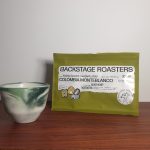
Colombia Monteblanco

Rating: 2.25 / 5
Coconut opened strong, then vanished. Yoghurt stayed, sweetness didn’t. Immersion gave balance, clarity exposed flaws. Espresso helped, but this co-ferment stayed more concept than cohesion. Interesting, but not compelling.
Monteblanco invites dialing but seldom rewards it. Too lean, too fleeting, and lacking transparency – more soundcheck than show.
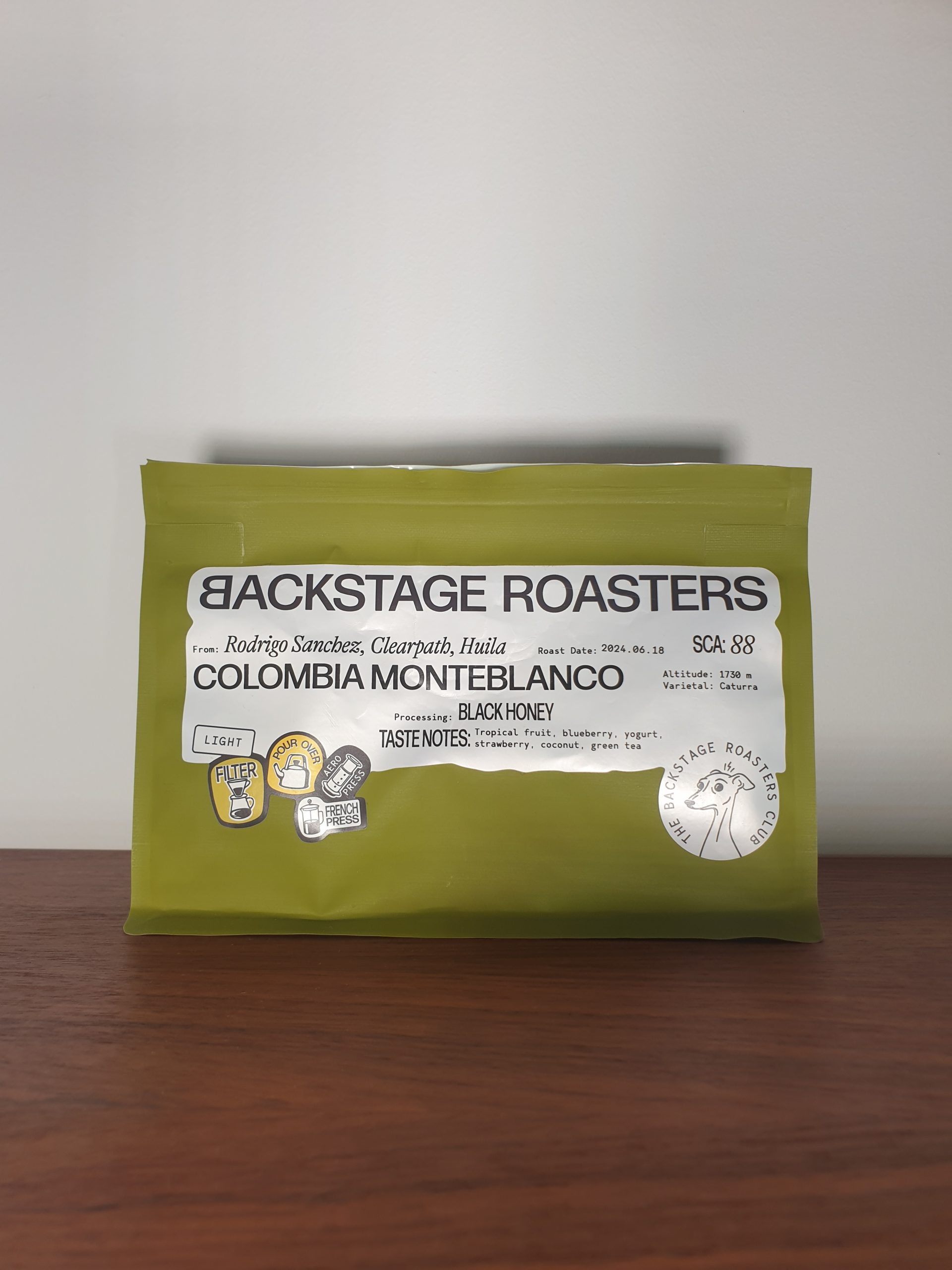
Coffee Name: Colombia Monteblanco
Roastery: Backstage Roasters
Country/Region: Colombia, Huila
Producer/Farm: Rodrigo Sanchez, Clearpath
Processing: Black Honey
Roast Degree: Light
Taste notes: Tropical Fruit, Blueberry, Yogurt, Strawberry, Coconut, Green Tea
MASL: 1730
Variety: Caturra
SCA Score: 88
Headlining Tropicals
Picked up during the World of Coffee event in Copenhagen, this coffee came with a small burst of optimism and curiosity. Amidst the chaos of booths, selfie sticks, and cupping spoons, I found myself at Backstage Roasters’ stand, drawn in not by branding or backstory, but by curious facial expressions from the small crowd that had gathered around the leaf-green booth. First, a small tasting, brewed on what looked like a Kalita 155 with high agitation, vibrant with yoghurt-like fermented creaminess and an intense but memorable crisp coconut and tangy tropicals, reminiscent of a piña colada and long days at the beach. It was intense yet balanced, sweet, and just strange enough to earn a spot in my bag by the end of the day.
Back home, the bag’s promise felt unusually loud—tropical fruit, blueberry, yoghurt, strawberry, coconut, green tea, and with a black honey process and Caturra at a respectable SCA score behind it, I expected something layered, fruit-forward, and structurally complex but clean. That initial booth sample had done its job. Expectations were firmly set somewhere between excitement and scepticism.
Knowing how much this kind of profile can shift with age, and how honey-processed coffees sometimes open up in uneven ways, I didn’t wait long to start brewing. First up: the test rig.
On my flat-bed setup, the results were sharp from the start. A high-pitched acidity drove the first sips; bright, tropical, and quick to fade. The sweetness followed more hesitantly, landing somewhere between under-ripe mango and pineapple juice diluted one part too far. Beneath that, a soft, lactic creaminess appeared: faint, but persistent, like a strawberry yoghurt left out a little too long on the countertop.
Coconut was present but not the main artist in this tropical brew. Blueberry and green tea were missing in action. The overall impression was clear, technically clean, but slightly unbalanced and thinner than expected, with definite notes that aligned with the brewing technique I observed at the booth initially.
Test Rig: 15g of coffee to 220g of water (1 : 14.67 ratio) aiming for a total brew time of 3 minutes on the Kalita Wave 155 Tsubame, original filters.
Water profile of 80 GH and 20 KH, with general hardness equally split between Magnesium and Calcium, and temporary hardness from sodium bicarbonate.
Pouring structure of 45s bloom and a single slow pour until final brew weight is reached, and water temperature of 92 degrees Celcius.
It, however, didn’t taste like a classic Colombian honey – too much coconut for that. It didn’t even taste like a clean fruit-forward light roast. It tasted like a co-ferment, and while that wasn’t mentioned on the packaging, I would later find confirmation on the roaster’s website that this was indeed a co-ferment with fruit nectar.
Fader Slips and Fine Adjustments
On a flat-bed, high-pour structure, the acidity was sharp, high-pitched and tropical, but lacking ballast. Pineapple was the clearest association, but not the fresh-cut version; rather, it was more like the reconstituted, juice-box version. The sweetness, barely present, came as an afterthought. A soft strawberry-yoghurt character flickered underneath, offering a fleeting illusion of balance. Coconut, which had defined the booth sample in Copenhagen, had already begun to fade, and over the following two weeks, it sadly disappeared entirely.
Tried on the V60, the acidity became piercing. Pineapple moved further into underripe territory, bright but shrill, and the structure thinned considerably. Boosting KH to buffer the sharpness brought the expected flattening effect, but without adding sweetness or cohesion. The profile became quiet, but not in a contemplative way, just muted. Texture-wise, the body was fragile, not tea-like as with many high-clarity brews, simply watery pineapple juice. A dialled pour gave clarity, yes, but not depth. The result: a single note held too long, on a thin string.
The flat-bed gave more control. Pushing grind finer and minimizing agitation helped rein in the acidity’s sharpness without collapsing the rest of the cup. At 96°C, and using a restrained, low-turbulence single-pour structure, the acidity rounded slightly, and the yogurt note gained a surprisingly delightful presence. Still, sweetness remained elusive. Without the coconut I experienced at first, the cup leaned toward something like boxed pineapple juice cut with yoghurt whey, tropical and creamy, but without a middle or end. Grind coarseness had to be carefully managed: finer helped round out the cup, but at the cost of clarity, especially if pouring structure wasn’t meticulously managed. On modern burr geometries, this became even more important. Finer grinding was helpful, especially at lower RPMs, where fines were better managed and didn’t overpower the structure. However, clarity came at a price: the cup became increasingly about acidity and texture, rather than sweetness or fruit complexity. Without modulation, this clarity simply exposed the cup’s imbalance.
What quickly became clear was that advection-heavy brews like the V60 with center-pour flow worked against this coffee. The rate at which fresh water passed through the bed favored sharp acids, pushed fermentation tang to the surface, and left everything else behind. Diffusion-based methods, on the other hand, offered a more engaging result in the cup. Drawing from observations, the extended steep and equalised concentration gradient of immersion brewing allowed more midtones to develop, leaning me into the Aeropress territory.
Aeropress gave, by far, the most enjoyable cups. Starting with a medium-coarse grind, closer to what I’d use for Chemex, and a long steep (7 minutes), the acidity finally mellowed into something textured and stable. Strawberry became clear and grounded, like walking through a strawberry field and not synthetic or floral, but soft and structured, with a creamy backnote. Further iteration with a slightly finer grind, a 5-minute steep, and 94°C yielded even better balance. The lactic processing still carried a forward presence, but no longer shouted. Acidity folded into the sweetness naturally. The flavour curve curved, pineapple tamed, and complexity rose.
Tea-like green structure never arrived. Blueberry appeared, but only when pushing grind too fine, at which point the profile became earthy, slightly dusty, and lost direction. Possibly a quirk of the fermentation, possibly my own preference – blueberry rarely reads cleanly to me – but it felt like an off-note when forced.
Water composition was again crucial. With a magnesium-leaning profile, the yellow tropicals came alive, mostly mango and passionfruit, but the sweetness dropped significantly. Calcium-forward water preserved the creaminess of the yoghurt and enhanced the strawberry note, making immersion brews especially compelling. KH in the 45–60 ppm range brought balance to acidity without dulling character. Below that, the tang dominated. Above that, the cup collapsed into softness without presence.
Ultimately, I found this coffee to respond best to low-agitation, slow-extraction styles. It resists control in fast-flow brewers – which might also say something about my pouring skills, who knows? It needs buffering, not boosting. And while clarity-focused burrs highlight its processing, they also risk laying it bare. This isn’t a forgiving coffee, it’s a directional one. It demands calibration across grinder geometry, water composition, temperature, and time. And without the fleeting coconut to balance that fermentation-forward profile, brewing becomes a question of how much of the co-ferment edge you want to let through, and how much you’re willing to lose in pursuit of sweetness that may never fully arrive.
Under Pressure … It Performs
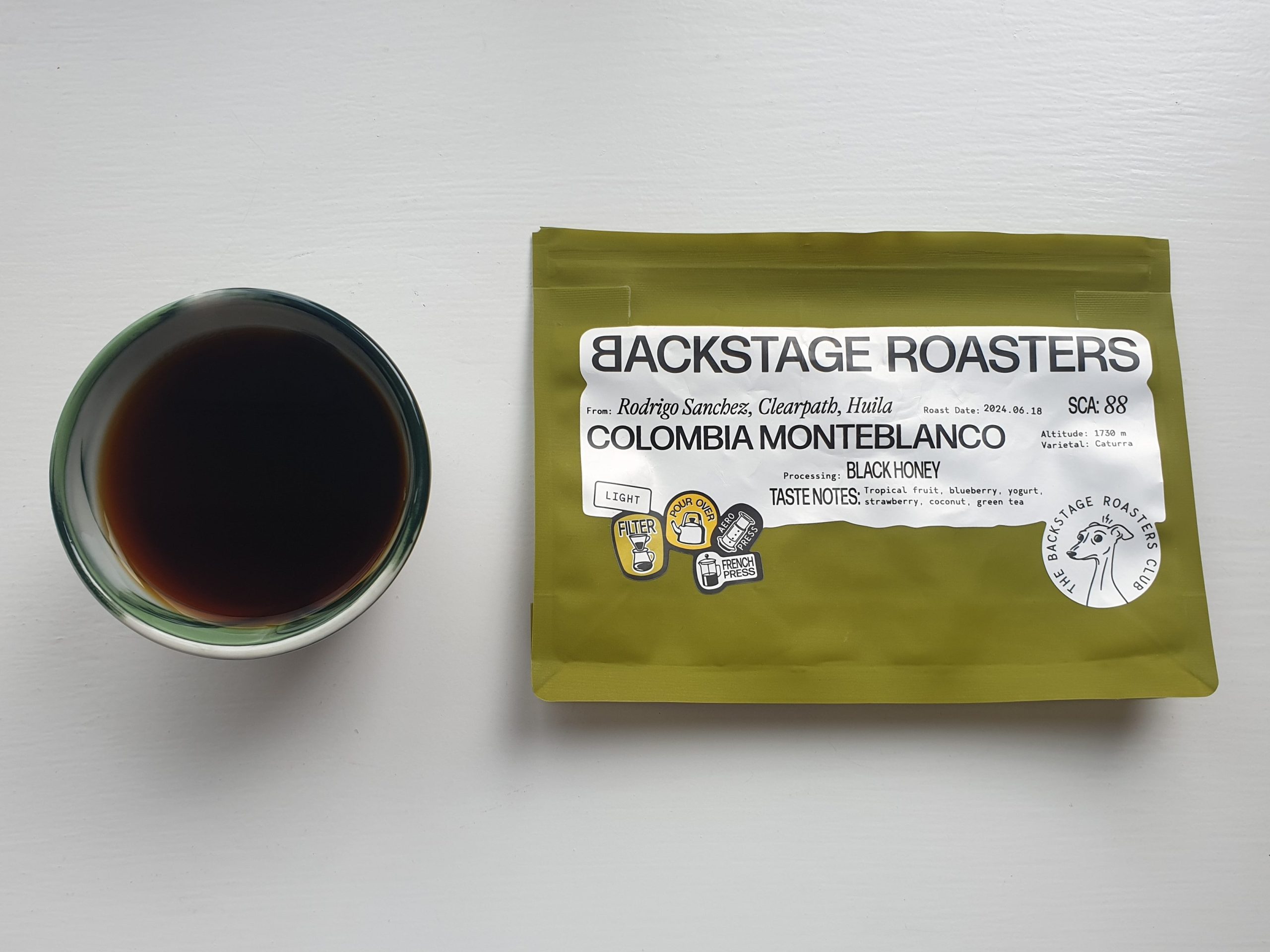
Pulled long at 18 grams in, 52 grams out, with a water profile of 110 GH and 85 KH, Monteblanco finally found some structure. On espresso, the acidity condensed into something more coherent, pineapple took a step back, and a softer, mango-like sweetness emerged. The lactic component that had shouted in filter methods now settled into something round and textured, like a creamy yoghurt base, rather than a fermented edge. To my surprise, the processing and roasting turned out to be a delight to work with when dialling in; no struggles and no annoyances.
KH proved essential. At this higher level, the buffer stabilised the acidity and gave the cup more presence. Sweetness, while still not dominant, was no longer absent; it surfaced gently in the finish, tied closely to the strawberry note, which gained a jam-like density under pressure. The result was tropical, creamy, and tight, a cup that made sense, even if it still hinted at something more experimental than the packaging on paper suggested.
Lowering the KH dropped body and let the acidity spike. Any attempt to push extraction shorter or tighter left the cup hollow and overly sharp. But when treated with enough space and a generous bicarbonate, Monteblanco offered its most complete performance in the cup: still unconventional, still slightly unresolved, but composed.
Fading Off
In the end, Monteblanco offered moments, fragments of clarity, texture, and interest, but never quite came together as a full composition. The strawberry-yoghurt base had promise and potential, and the brief flash of coconut in those early days hinted at something bigger, bolder, and possibly also what Backstage Roasters intended – but it faded much too quickly. Whether it was the co-ferment edge, the vanishing sweetness, or the structure that just never stabilised, the cup kept slipping through the gaps. No method ever pulled everything into focus for me.
I’m still looking for a co-ferment that delivers balance without shouting, structure with restraint, and flavour that evolves rather than vanishes. This wasn’t it. A coffee with potential, but too dependent on tight parameters, and too quick to lose its spark.
My best brew with the Colombia Monteblanco from Backstage Roaters:
Brewer: Aeropress
Water Profile: 60 GH (35 Mg and 25 Ca), 55 KH, TDS: 115 ppm
Ratio: 1 : 16.1 (11.5g : 185g)
Pouring Structure: Single 185g pour
Total Brew Time: 5 minutes
Taste notes: Mango, Strawberry, Pineapple, Yoghurt
Body and mouthfeel: Medium-thin, Coating
Rating: 2.25 / 5